
- Gobi Desert
- Khongor Sand Dunes
- Bayanzag Flaming Cliffs
- Yolyn Am
- Tsagaan Suvarga
- Bactrian camel
- Mongolia tour
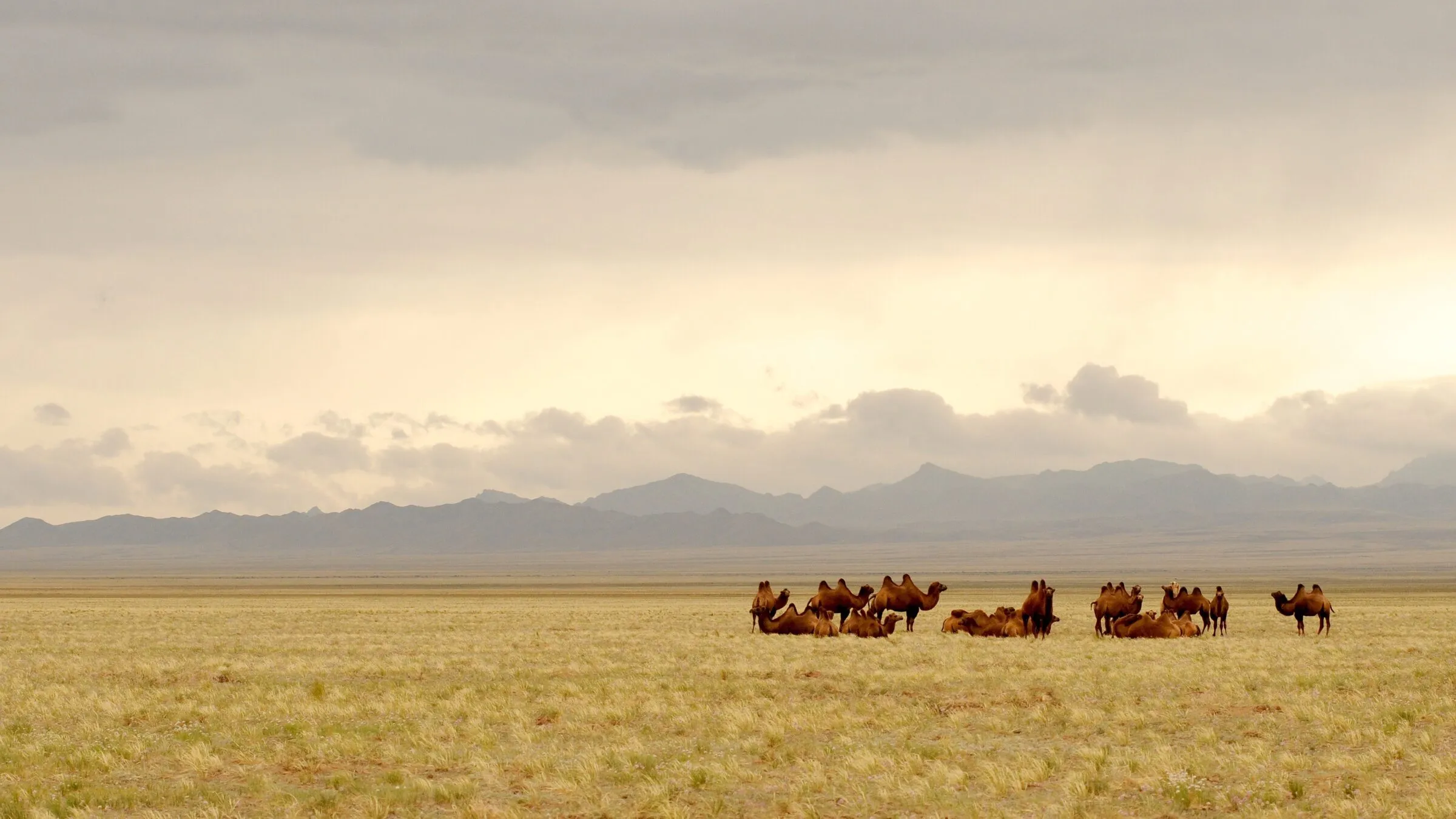
The Gobi Desert is the part of Mongolia most travelers picture before they arrive, wide, empty, geologic. It is also the part that surprises them most. The Gobi is a cold desert, not a Sahara. Daytime summer temperatures sit around 30 to 35 degrees Celsius, but nights drop sharply, and snow falls into May. The dryness keeps the air clear, the stars dense, and the colours saturated. Bactrian camels and the rarely-seen snow leopard live here; the camels graze most of the route.
This is what a typical Gobi week looks like, drawn from the trips we run, the 6-day, 7-day, 8-day, 9-day, and 10-day Gobi-and-Central. The four landmark Gobi sites are the same on every variant: Tsagaan Suvarga, Yolyn Am, the Khongor Singing Dunes, and the Bayanzag Flaming Cliffs.
Distance is part of the trip
The Gobi loop runs roughly 1,800 to 2,000 kilometers from Ulaanbaatar and back, depending on which sites you include. Most of that is on dirt and gravel tracks south of the paved network, slower than highway driving, but the country between sites is part of the trip. We travel by Toyota Land Cruiser; group sizes are two to six guests. Most days include four to seven hours of driving with stops every 90 minutes. The touring days at Khongor, Bayanzag, and Yolyn Am are shorter, with walks, climbs, and rides built in.
The Dalanzadgad airstrip in the south Gobi makes one-way flight options possible on the 6-day and 7-day itineraries, fly down, drive back, or vice versa. That trims roughly two long driving days off the route, which some travelers prefer and others miss. The driving is part of the country’s character; there’s no shortcut that delivers the same experience.
Tsagaan Suvarga
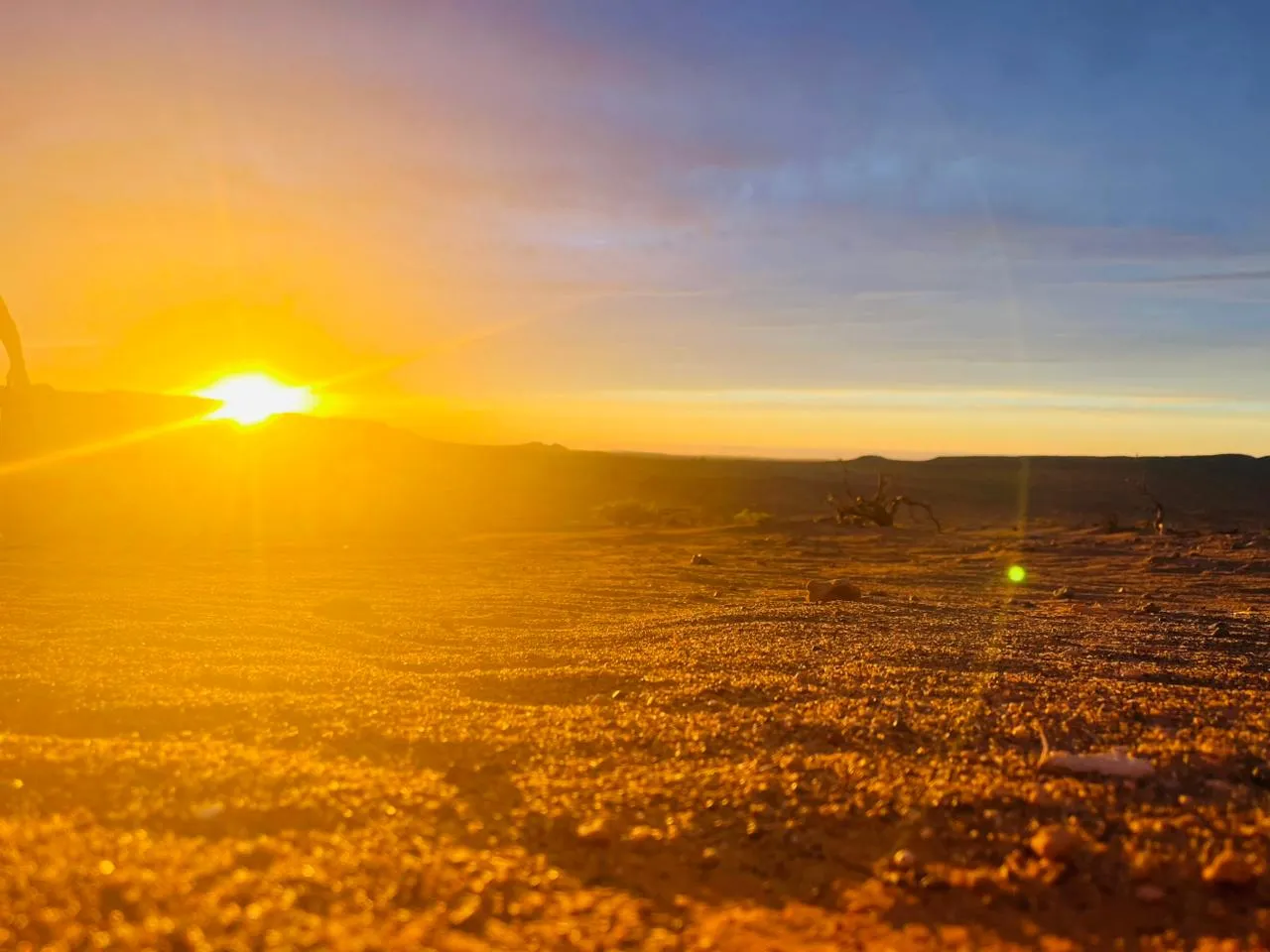
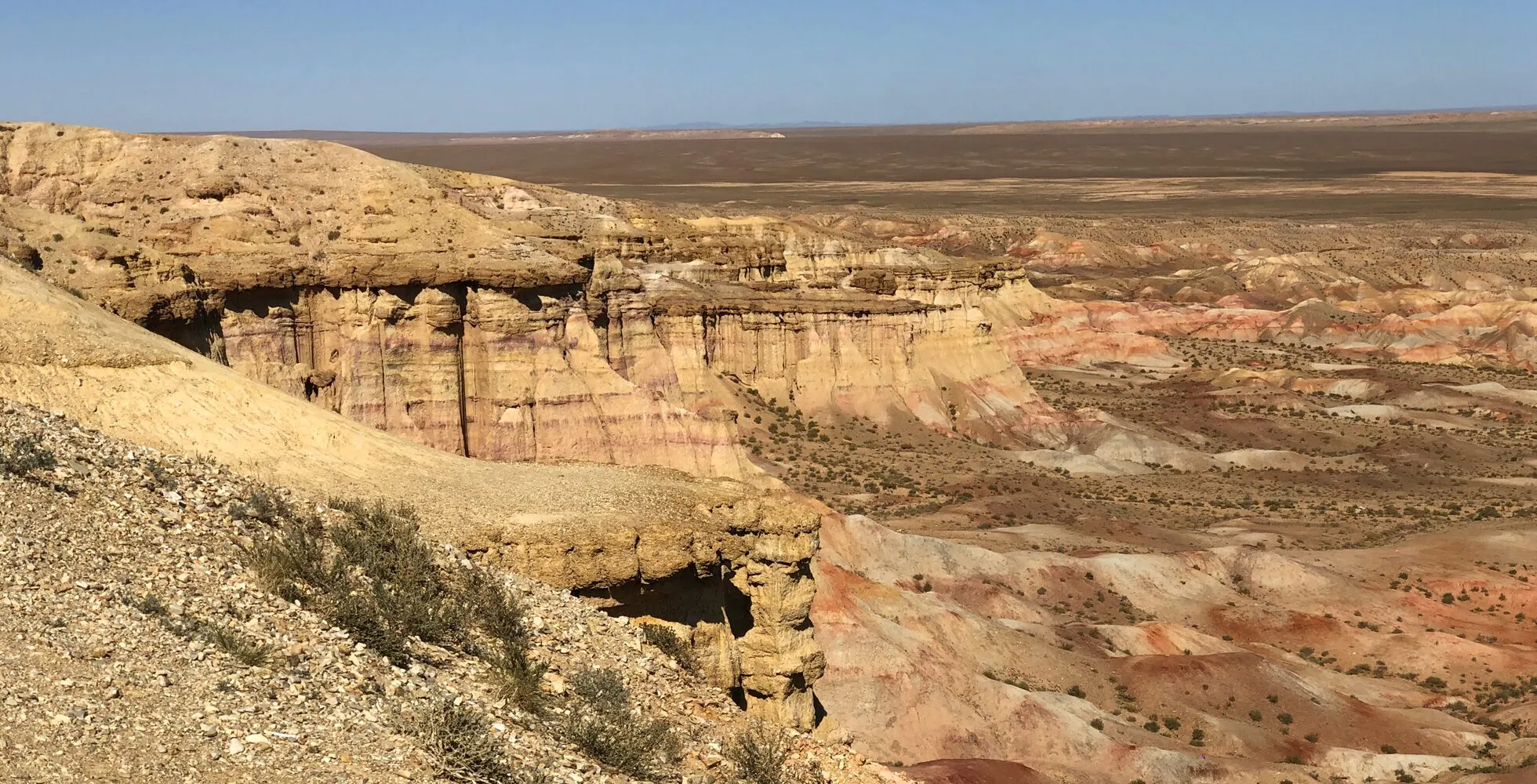
Most loops start with Tsagaan Suvarga, the “White Stupa”, a 60-meter limestone escarpment in eastern Gobi, eroded into ridges and pinnacles that catch the morning light. The cliffs were the bed of an inland ocean 90 million years ago; marine fossils still surface in the gullies below. It is the first major site on most Gobi itineraries, often timed for sunrise or late afternoon when the white stone runs orange.
This is the introduction to the Gobi’s geology. Travelers who arrive expecting “desert” in the Saharan sense usually realize at Tsagaan Suvarga that the Gobi is older and stranger, sedimentary, prehistoric, layered.
Yolyn Am ice canyon
Yolyn Am is a narrow valley in the Gurvan Saikhan Mountains, shaded by walls steep enough to keep ice on the canyon floor into late June or early July. The walk in is gentle, around four kilometers each way along the stream. The cliffs are home to wallcreepers and the rare lammergeier. The name means “Vulture Valley.”
Whether you’ll see ice depends on when you come. By mid-summer the ice has typically melted; the walk in is still beautiful, with the cliffs, the small stream, and the chance to spot wallcreepers and the occasional lammergeier. We’ve had guests in early June walk on solid ice; we’ve had guests in late July on bare gravel. Both are real Gobi.
Khongor Singing Dunes
Khongor Els is the Gobi’s signature landscape. The Khongor dunes, also called the Singing Dunes for the low resonant note they produce when wind crosses them at the right angle, run 180 kilometers along the foot of the Altai Mountains. The tallest reach 80 meters.
Most Gobi itineraries include a Bactrian camel ride at Khongor, usually 30 to 60 minutes, gentle, suitable for beginners. The two-humped camels are a different species from the Arabian dromedary; their pace is slow and comfortable, very different from a horse. Climbing one of the high dune faces is a 30 to 45 minute scramble through soft sand, and the descent takes about ten. It is steep but not technical. The view from the ridge stretches across the dune chain as far as the haze allows.
We spend at least one night with a nomadic camel-herding family at the foot of the dunes. The visit is on the family’s terms; you sit, drink salty milk tea, and learn the rhythm of a household that moves four times a year with the seasons. This is often the night travelers come back talking about.
Bayanzag Flaming Cliffs
In 1922, the American naturalist Roy Chapman Andrews led an expedition into the Gobi and found the world’s first known dinosaur eggs at Bayanzag. The red sandstone cliffs glow at sunset, the source of the English name “Flaming Cliffs”, and the ground is still strewn with fossil fragments. The site is small; you walk it in an hour. The history is what makes it worth the stop.
A note: removing fossils from the site is illegal under Mongolian law. They are part of the national archaeological record. The site is still actively researched.
What the longer variants add
The 6-day covers the four landmark sites in a tight loop. The 7-day adds Baga Gazariin Chuluu (a granite-rock formation in Dundgovi province) on Day 1 and Ongi Monastery on Day 7. The 8-day and 9-day add Karakorum and Erdene Zuu Monastery on the return, the cultural core of Central Mongolia wedged into the Gobi loop. The 10-day Gobi-and-Central tour combines the full Gobi loop with the full Central core. Karakorum, Tovkhon Monastery, Tsenkher Hot Springs, and is the most popular combined option for travelers with two weeks.
For travelers comparing regions, a Gobi Desert tour is the obvious second Mongolia trip after a Central tour. It is also a strong first trip if you are most drawn to desert landscape, fossils, and remote driving.
When to come
The Gobi season runs May through September. June through August is peak: warm days around 30°C, cool nights, all ger camps fully open, the Khongor dunes accessible. May and September are good shoulder months, fewer travelers, cooler nights, shoulder light on the cliffs. We don’t run Gobi tours from October through April: most ger camps close, and the unpaved sections of the route can become unreliable in the cold.
If you have two weeks and want both the Gobi and the cultural sites of Central, the 10-day combined tour is the answer. Otherwise the planning guide lays out the rest of the options. Tell us your dates and Baska comes back with a route within a week.
Related reading
-
A week in Central Mongolia: Karakorum, the Orkhon Valley, and Tovkhon
What a typical week in Central Mongolia looks like, the road from Ulaanbaatar to the imperial capital, what each day actually contains, and why this is the best first trip to Mongolia.
-
The Altai and the Kazakh eagle hunters: a Western Mongolia trip
What a Western Mongolia tour involves, driving 1,500 kilometers to Bayan-Ölgii, Altai Tavan Bogd, the Kazakh eagle hunters, the Golden Eagle Festival in October.
-
Choosing your first Mongolia trip
A short guide to picking a Mongolia tour by length, season, and region, with the trade-offs we tell every traveler before they book.
If this was useful, the next step is either a fixed itinerary or a custom one. Both start with a conversation.