Skip to content
A landscape from Gobi Mongolia: singing dunes, flaming cliffs, dinosaur fossils.

6–10 days · 6 itineraries

The Gobi Desert.

Tsagaan Suvarga, the Khongor singing dunes, the Flaming Cliffs at Bayanzag, Yoliin Am ice canyon. Six itineraries from six to ten days, all out of Ulaanbaatar.

On this page

Gobi Mongolia.

A Gobi Desert tour takes you through Mongolia's southern third – a high, dry, rocky desert that bears almost no resemblance to the Sahara. Tsagaan Suvarga's white limestone cliffs were once an ocean bed; marine fossils still surface. Yoliin Am is a deep canyon in the Gurvan Saikhan Mountains, shaded enough to keep ice into late June. The Khongor Singing Dunes run 180 kilometers along the foot of the Altai, 80 meters at their tallest, and audible when wind crosses them at the right angle. Bayanzag's Flaming Cliffs are where Roy Chapman Andrews found the world's first dinosaur eggs in 1922.

All six of our Gobi itineraries begin and end in Ulaanbaatar. Most of the route runs on dirt and gravel tracks – longer days behind the wheel than a Central Mongolia tour, but the country between sites is part of the trip. Travel is by Toyota Land Cruiser, accommodation alternates between ger camps and overnights with nomadic families, and camel riding at the Khongor Dunes is included on every variant. The longer Gobi tours (8 to 10 days) combine the Gobi loop with the Central Mongolia core – Karakorum, Tovkhon Monastery, Tsenkher Hot Springs – on the return.

Why a Gobi Desert tour.

The Gobi is the part of Mongolia most travelers picture when they imagine the country – wide, empty, geologic. It is also a cold desert. Daytime summer temperatures sit around 30 to 35 degrees Celsius, but nights drop sharply, and snow falls into May. The dryness keeps the air clear, the stars dense, and the colors saturated. Bactrian camels and snow leopards live here; the latter are rarely seen, but the former graze most of the route.

For travelers comparing regions, a Gobi Desert tour is the obvious second Mongolia trip. A Central Mongolia tour is usually the first visit; the Gobi is where you go on the second, or as the wider loop on a single longer trip. The Altai Mountains in Western Mongolia and Khuvsgul Lake in the north are quieter still – better suited to a third or fourth visit, or to travelers with a specific interest in eagle hunters or reindeer herders.

Gobi distances are longer than Central. Plan for 5 to 7 hours of driving on transfer days, with shorter touring days in between. The road network is mostly unpaved tracks, which slow the pace but keep the country open in front of you the whole way. The Dalanzadgad airstrip in the south makes one-way flight options possible on some itineraries, cutting a long return drive.

What to see on a Gobi Desert tour.

01

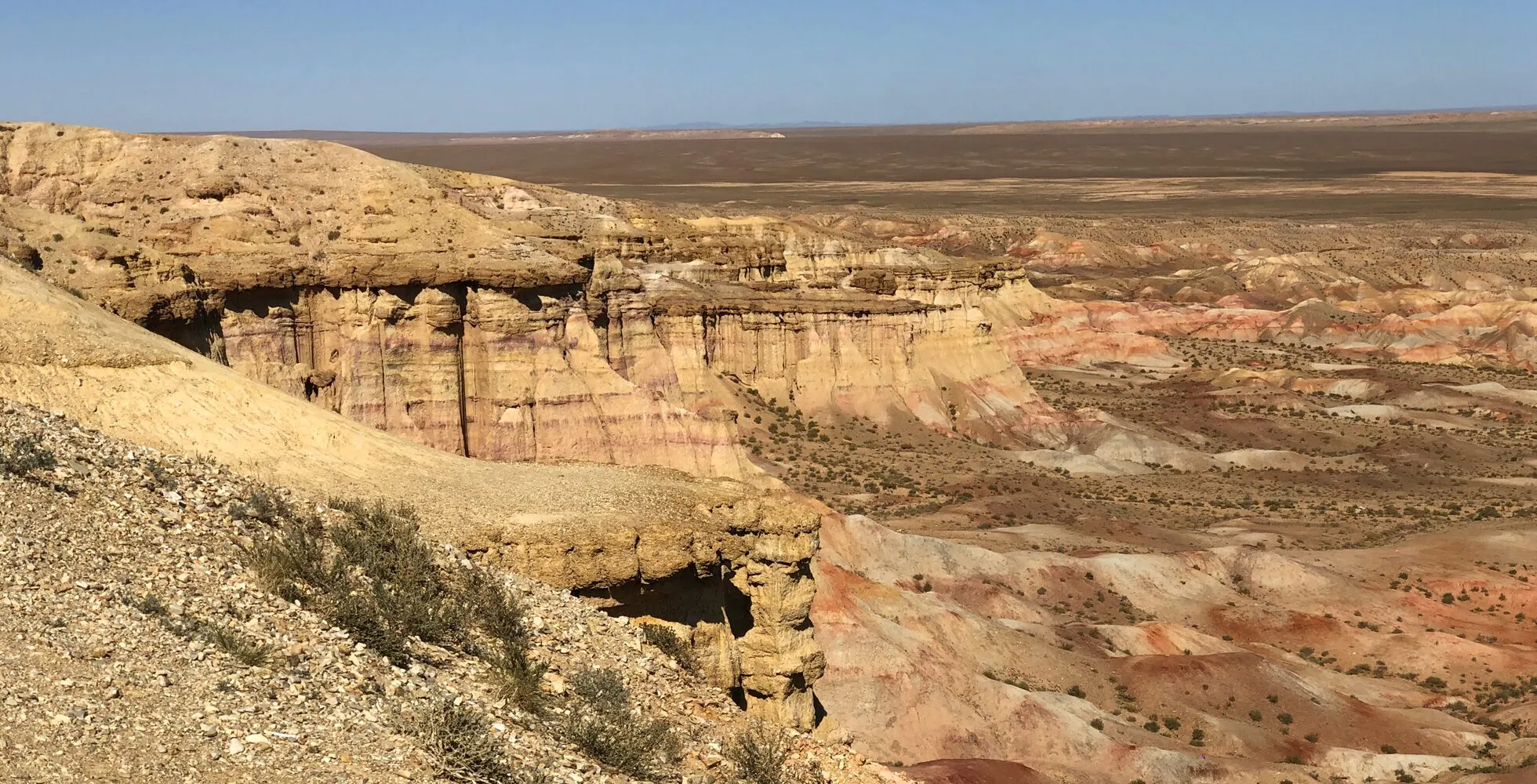
Tsagaan Suvarga

The "White Stupa" – a 60-meter limestone escarpment in eastern Gobi, eroded into ridges and pinnacles that catch the morning light. The cliffs were the bed of an inland ocean 90 million years ago; marine fossils still surface in the gullies below. It is the first major site on most Gobi itineraries, often timed for sunrise or late afternoon when the white stone runs orange.

Tsagaan Suvarga, Gobi Mongolia.

02

Khongor Sand Dunes

The Khongor dunes – also called the Singing Dunes for the low resonant note they produce when wind crosses them at the right angle – run 180 kilometers along the foot of the Altai. The tallest reach 80 meters. A short two-humped Bactrian camel ride takes you to the base; climbing one of the high faces is a 30 to 45 minute scramble through soft sand, and the view from the ridge stretches as far as the air allows.

03

Bayanzag Flaming Cliffs

In 1922, the American naturalist Roy Chapman Andrews led an expedition into the Gobi and found the world's first dinosaur eggs at Bayanzag. The red sandstone cliffs glow at sunset – the source of the English name – and the ground is still strewn with fossil fragments. The site is small; you walk it in an hour. The history is what makes it worth the stop.

04

Yoliin Am ice canyon

A narrow valley in the Gurvan Saikhan Mountains, shaded by walls steep enough to keep ice on the canyon floor into late June or early July. The walk in is gentle, around 4 kilometers each way along the stream, and the cliffs are home to wallcreepers and the rare lammergeier. The name means "Vulture Valley."

05

Nomadic camel families

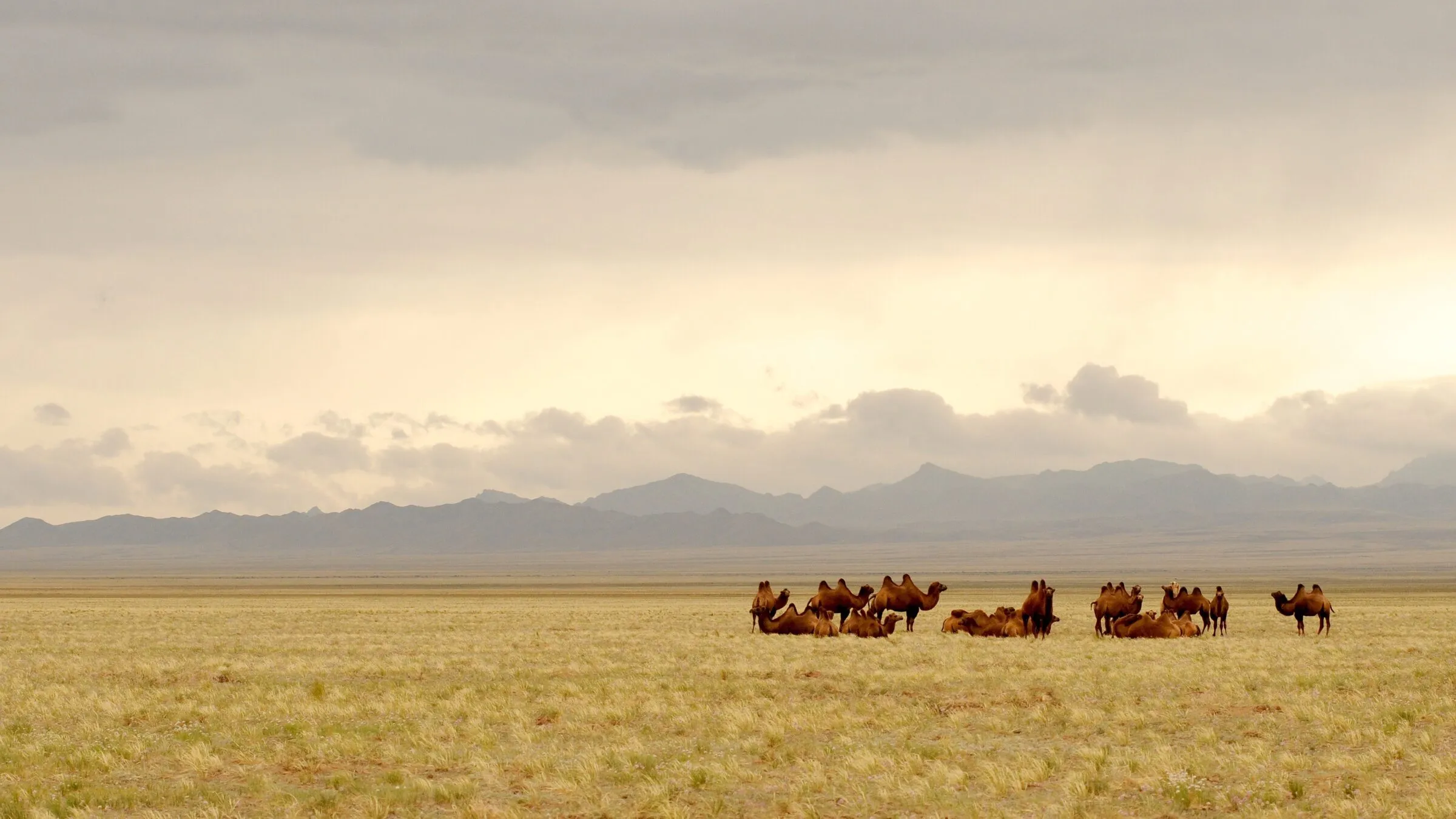
Most Gobi itineraries include at least one night with a nomadic camel-herding family. The two-humped Bactrian camels – different species from the dromedaries of the Middle East – are still bred here for milk, wool, and transport. The visit is on the family's terms; you sit, drink salty milk tea, and learn the rhythm of a household that moves four times a year with the seasons.

When to take a Gobi Desert tour.

The Gobi Desert tour season runs May through September. June through August is peak: warm days, long daylight, all ger camps fully open, the Khongor dunes accessible. Daytime temperatures sit around 28 to 35 degrees Celsius; nights drop to 10 to 15. Wind picks up in the afternoons – worth knowing for camel rides on the open steppe.

May and September are the shoulder months, and many travelers prefer them. Fewer tourists, cooler nights, the spring green still on the higher steppe in May, and gold light on the cliffs in September. We do not run Gobi tours from October through April – ger camps close, and the unpaved sections of the route can become unreliable in the cold months.

How our Gobi tours run.

All Gobi Desert tours start and end in Ulaanbaatar. Travel is by Toyota Land Cruiser or equivalent, appropriate to the rough tracks south of the paved network. Accommodation alternates between established ger camps (private bedding, communal dining, shared showers) and overnight stays with nomadic camel-herding families on the steppe. Camel riding at the Khongor Dunes and an evening at the Flaming Cliffs are common to all variants.

Most days include 4 to 7 hours of driving with stops every 90 minutes; the touring days at Khongor, Bayanzag, and Yoliin Am are shorter, with walks, climbs, and rides built in. Group sizes are two to six guests – the trip you book is your trip, with your group only. We do not run scheduled departures with strangers. Drivers are people we have worked with for years, and Buya (our tour leader) joins each trip in person.

Itineraries

Tour Days Adds Skips Best for Ask
Gobi Desert · 6 days 6 days Core four-landmark Gobi loop Baga Gazariin Chuluu, Ongi Monastery Travelers who want the Gobi tightly, with no extra stops Ask →
Gobi Desert · 7 days 7 days Baga Gazariin Chuluu (Day 1), Ongi Monastery (Day 7) Combined-region detours (no Karakorum, no Terelj) Travelers focused on the Gobi who want the granite-rock and monastic additions Ask →
Gobi and Central Mongolia · 7 days 7 days Two final days at Terelj National Park near Ulaanbaatar Karakorum / Erdene Zuu Travelers wanting Gobi plus the Terelj rocks before flying out Ask →
Gobi Desert · 8 days with Karakorum 8 days Karakorum and Erdene Zuu Monastery on the return Tovkhon Monastery, Tsenkher Hot Springs (added on the 9 and 10 day) Travelers wanting Gobi plus the imperial capital Ask →
Gobi and Karakorum · 9 days 9 days Karakorum, Erdene Zuu, Tovkhon Monastery, Tsenkher Hot Springs The full 10-day Gobi-and-Central core sites Travelers wanting more time at Karakorum than the 8-day allows Ask →
Gobi and Central Mongolia · 10 days 10 days Karakorum, Erdene Zuu, Tovkhon Monastery, Tsenkher on the return Western or Northern detours Travelers with two weeks who want both Gobi and Central in one loop Ask →

6 days · May – September

Gobi Desert · 6 days

The core Gobi loop: Tsagaan Suvarga limestone cliffs, Yoliin Am ice canyon, the Khongor Singing Dunes with camel riding, and the Flaming Cliffs at Bayanzag.

7 days · May – September

Gobi Desert · 7 days

An expanded Gobi loop adding Baga Gazariin Chuluu granite mountains and Ongi Monastery to the four landmark Gobi sites.

7 days · May – September

Gobi and Central Mongolia · 7 days

The core Gobi loop framed with Khugnu Khan and Terelj National Park: rocky-formation landscape on the way out and dunes on the way back.

8 days · May – September

Gobi Desert · 8 days with Karakorum

Eight days combining the core Gobi loop with two days at Karakorum and Erdene Zuu Monastery on the return.

9 days · May – September

Gobi and Karakorum · 9 days

Nine days combining Terelj, the full Gobi loop, Karakorum, and Khugnu Khan – the most varied of the Gobi-Central combinations.

10 days · May – September

Gobi and Central Mongolia · 10 days

Ten days combining the full Gobi loop with the full Central Mongolia core – Karakorum, Tovkhon, Tsenkher Hot Springs, the Orkhon Valley.

Itineraries flex to your dates. Talk to us about adjusting routing, pacing, or season.

Gobi Desert tour: common questions.

What is the best time to visit the Gobi Desert?

June through August is peak season for a Gobi Desert tour – warm days around 30°C, cool nights, all ger camps open, the Khongor dunes accessible. May and September are good shoulder months: fewer travelers, cooler nights, and shoulder light on the cliffs at sunrise and sunset. We do not run Gobi tours from October through April – most ger camps close, and the unpaved sections of the route can become unreliable in the cold.

How many days do I need for a Gobi Desert tour?

Six days is the minimum for a complete Gobi loop covering Tsagaan Suvarga, Yoliin Am, the Khongor Sand Dunes, and the Bayanzag Flaming Cliffs. Seven days adds an extra day at the dunes or a longer hike at Yoliin Am. Eight to ten days combine the Gobi loop with the Central Mongolia core (Karakorum, Tovkhon Monastery, Tsenkher Hot Springs) on the return – the most popular combined option for travelers with two weeks in Mongolia.

Can I climb the Khongor Sand Dunes?

Yes. The Khongor dunes run 180 kilometers and reach 80 meters at their highest point. A short Bactrian camel ride takes you to the base; the climb itself is 30 to 45 minutes through soft sand, and the descent takes about ten. It is steep but not technical – moderate fitness is sufficient. Most travelers climb one face. The ridge view stretches across the dune chain as far as the haze allows.

Are there really dinosaur fossils at the Flaming Cliffs?

Yes. Bayanzag is where Roy Chapman Andrews led the 1922 expedition that found the world's first known dinosaur eggs. The site is still actively researched, and the ground is strewn with fragments of bone and shell. Removing fossils from the site is illegal under Mongolian law – they are part of the national archaeological record. The Flaming Cliffs themselves are a small site; you walk the rim in an hour.

Is there really ice in Yoliin Am in summer?

Yes – usually. Yoliin Am is a narrow canyon in the Gurvan Saikhan Mountains, shaded by walls steep enough to hold ice into late June and sometimes early July. By mid-summer the ice has typically melted; the walk in is still beautiful, with cliffs, the small stream, and good chances of spotting wallcreepers and the occasional lammergeier. The walk is around 4 kilometers each way and gentle.

What is included in a Gobi Desert tour?

Specific inclusions confirmed at booking; typically: private vehicle and English-speaking driver, all accommodation (ger camps and one or two nomadic family stays), all meals on tour, all park and entrance fees, bottled drinking water, the Khongor camel ride, and the Yoliin Am hike. Excluded: international flights, Ulaanbaatar hotel nights, optional one-way flights to or from Dalanzadgad, gratuities. Final inclusions are confirmed in writing before any payment.

Can I fly to the Gobi instead of driving?

Yes, on some itineraries. Domestic flights run between Ulaanbaatar and Dalanzadgad in the south Gobi (around 90 minutes). One-way flight options are available on the 6-day and 7-day Gobi tours – fly down, drive back, or vice versa – which trims roughly two long driving days off the route. Flights are seasonal and weather-dependent; we confirm availability and pricing at booking.

Where do you stay on a Gobi Desert tour?

Most nights are at established ger camps – traditional felt tents with private bedding, communal dining, and shared shower and toilet facilities. One or two nights are with nomadic camel-herding families in their working ger camps; those are simpler (no shower) but the more authentic experience of the route. The first and last night of every itinerary are at your Ulaanbaatar hotel.

How does the Gobi compare to Central Mongolia?

Central Mongolia is steppe, monasteries, and imperial heritage – a softer landscape, shorter distances, paved roads for much of the way. The Gobi is desert, fossils, dunes, and longer drives on dirt tracks. Central is the obvious first-time-in-Mongolia trip; the Gobi is the obvious second. Travelers with two weeks often combine them on the 10-day Gobi-and-Central tour, which covers both regions in a single loop.

Do I need to ride a camel?

Camel riding is included as an optional activity at the Khongor Sand Dunes – usually 30 to 60 minutes, gentle, suitable for beginners. It is not required. Non-riders can hike, walk, or relax at the ger camp instead. The camels are two-humped Bactrian camels (a different species from the Arabian dromedary) and they have a slow, comfortable pace very different from a horse.

Tell us what you want to see.

Baska replies personally, in your language. There is no obligation.

Chat on WhatsApp Baska replies within 24 hours, Mon–Sat (UB time). Contact
Inquire about this region

Compare tours