
- Western Mongolia
- Bayan-Ölgii
- Altai Tavan Bogd
- Kazakh eagle hunters
- Golden Eagle Festival
- Tsagaan Salaa petroglyphs
- Mongolia Altai tour
Western Mongolia is the most remote, most distinctive part of the country. Bayan-Ölgii is 1,500 kilometers from Ulaanbaatar, farther than New York to Chicago, and the province sits at altitudes mostly above 2,000 meters. The landscape is mountain rather than steppe: Altai Tavan Bogd’s five sacred peaks reach 4,374 meters at Khüiten, the country’s highest point. The Potanin Glacier flows from the same massif. The petroglyphs in the Tsagaan Salaa-Baga Oigor valley are a UNESCO World Heritage Site, with around 10,000 carvings spanning from the late Pleistocene to the Bronze Age.
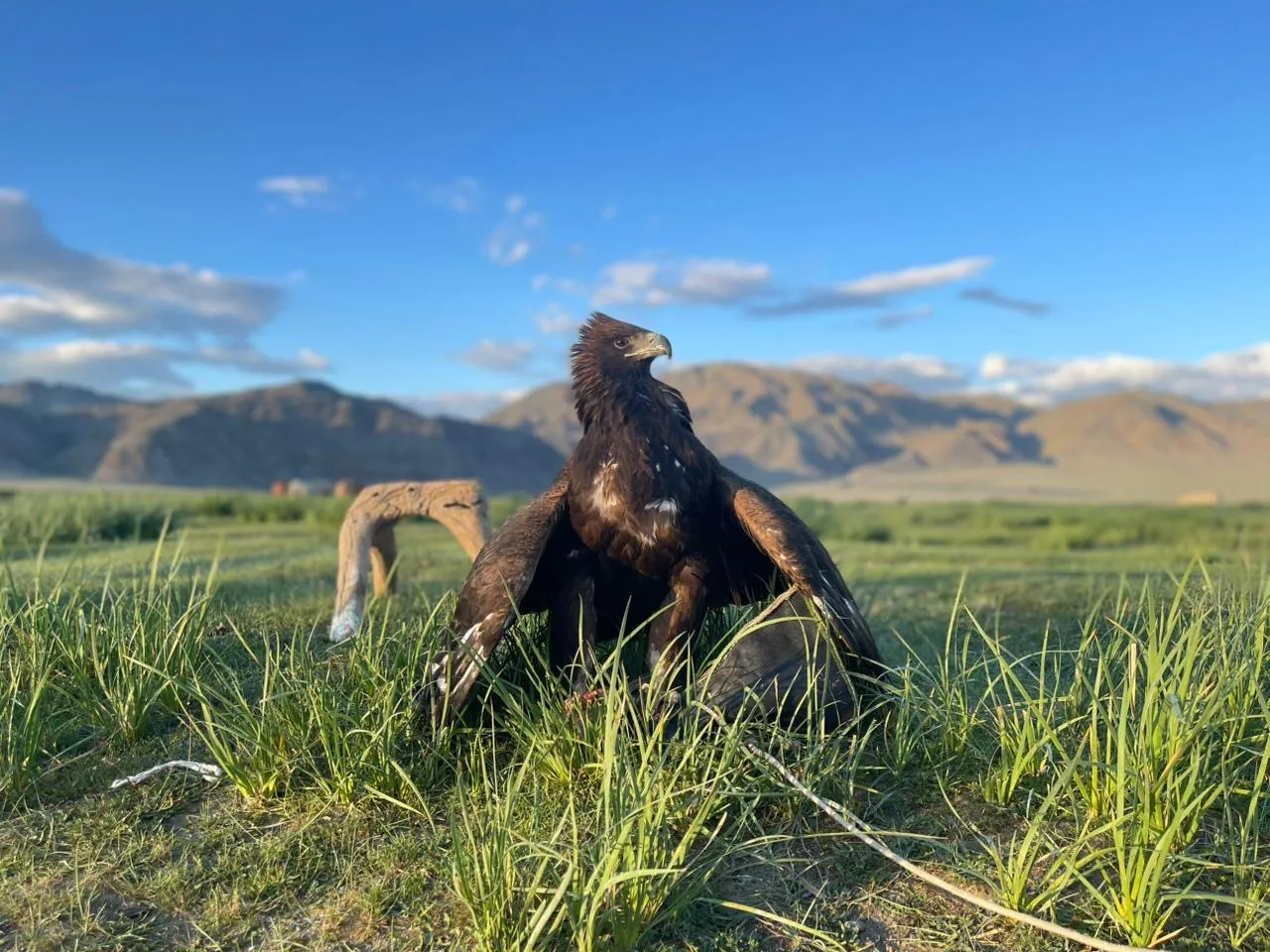
Most travelers come to Bayan-Ölgii for the Kazakh eagle hunters. The tradition, training golden eagles to hunt fox, marmot, and corsac fox from horseback in the winter, is genuinely alive here, not staged for tourism. Around 250 to 300 active eagle hunters work their birds across the province; the Golden Eagle Festival in early October has documented and celebrated the practice since 1999.
Three Western itineraries
We run three Western variants, each suited to a different kind of trip. The 8-day Golden Eagle Festival tour flies from Ulaanbaatar to Ulgii in early October for the festival itself. The 14-day Western round trip drives the country. Karakorum, Khyargas Lake, the Uvs Lake biosphere, the Altai, and returns by the same route. The 22-day grand expedition splices Northern Mongolia (with the Tsaatan reindeer herders) and a south-Khangai loop into the western route, returning by air from Uliastai. Travel is by Toyota Land Cruiser; the long days behind the wheel are part of the trip.
Why the drive matters
For travelers comparing regions, Western Mongolia is usually a fourth or fifth Mongolia trip, or the destination of a focused trip specifically for the Altai or the Golden Eagle Festival. The drive across the country is part of the experience. Travelers with less time can fly to Bayan-Ölgii (the 8-day Golden Eagle Festival tour does this); travelers with more time tend to splice Western with Northern (the 22-day grand expedition) for the longest standard Mongolia trip we run.
The driving distances are real. From Ulaanbaatar, the 14-day route covers roughly 4,000 kilometers across two weeks. The road network is mostly unpaved tracks west of Khovd, which slow the pace but keep the country open in front of you the whole way. Plan for six to eight hours of driving on transfer days, with shorter touring days at the lakes, the petroglyphs, and the Tavan Bogd.
The eagle hunter visit
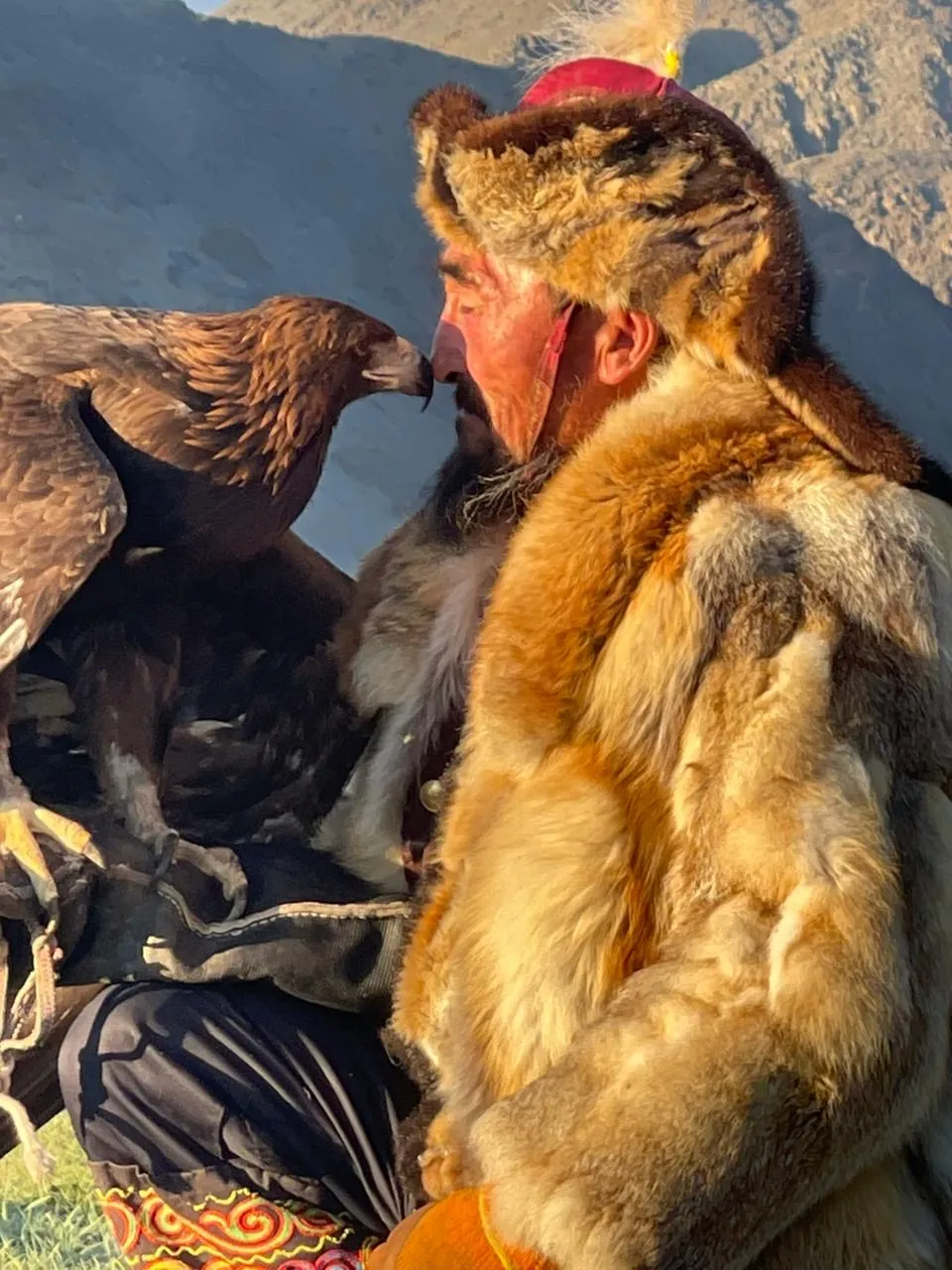
A visit to a Kazakh eagle hunter family in their summer ger camp, not staged for tourism, is included on the 14-day, 22-day, and Golden Eagle Festival tours. The tradition has been documented in Persian and Mongol records from the 13th century. The hunters work their birds in winter against fox and marmot, training young eagles for around five years before releasing them back to the wild. In summer, the eagle is at home in the camp; you’ll see it perched, fed, and handled by the hunter. The visit is on the family’s terms.
Travelers who want this part of the trip on a tighter schedule should choose the 8-day Golden Eagle Festival tour. The festival itself runs two days at the Sayat Tolgoi grounds outside Ulgii, with around 80 to 100 active eagle hunters competing across categories: how the eagle responds to its hunter from a high cliff release, the eagle’s accuracy on a fox-fur lure, the speed of the call-back. The festival was documented internationally by the 2016 film The Eagle Huntress and has become the most-photographed event in Mongolia.
Altai Tavan Bogd
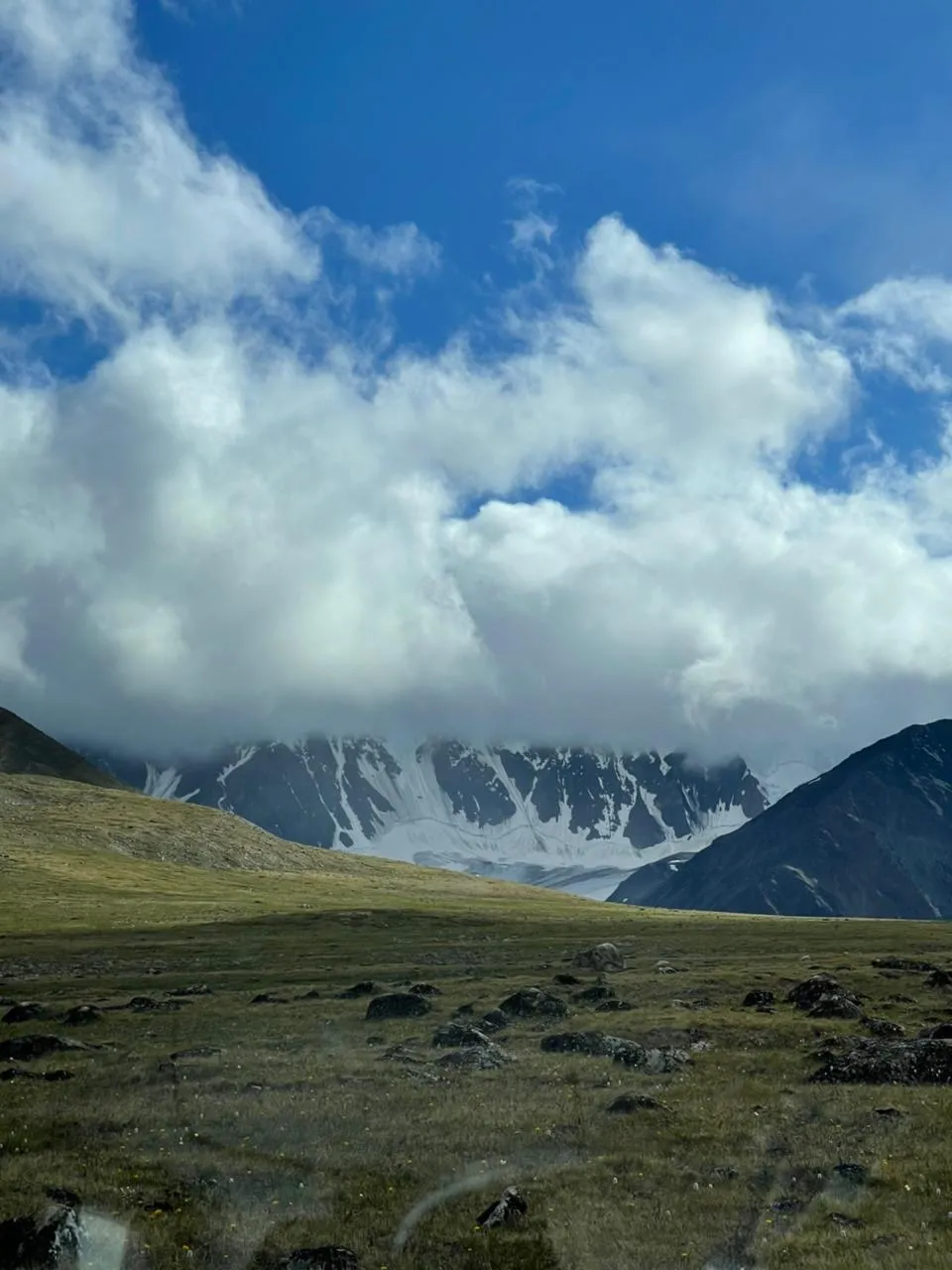
Altai Tavan Bogd National Park covers the Five Sacred Peaks of the Altai. Khüiten (4,374m, the country’s highest point), Naran, Ölgii, Burged, and Nairamdal. The Potanin Glacier is the largest in Mongolia. The Khoton, Khurgan, and Dayan alpine lakes lie at the eastern foot of the peaks. The park is reachable by 4WD from Ulgii (around 6 hours) and accessible to non-climbing visitors at the lower-elevation lakes and viewpoints.
We do not climb the peaks themselves, that requires technical mountaineering and is not what our trips are. The standard hiking around the lakes and viewpoints is enough to feel the scale of the place. The high passes reach 4,000 meters; we acclimatize gradually and the standard hiking does not require technical climbing experience. Travel insurance with medical evacuation cover is required for all guests.
The petroglyphs
The Tsagaan Salaa-Baga Oigor petroglyphs are a UNESCO World Heritage Site of around 10,000 rock carvings in the upper valley of the Tsagaan Salaa River. The carvings span from the late Pleistocene (around 11,000 BCE) through the Bronze Age. They show extinct mammoths, woolly rhinoceros, ostriches, and the early stages of horse domestication. The site is reached by a short hike from the road and is included on the 14-day and Golden Eagle Festival tours.
This is one of the longest continuous records of human artistic expression anywhere in the world. The figures are small, often a few centimetres tall, scattered across a long valley. Walking the site, you see human figures, hunting parties, and animals from a deep prehistoric past. It is a quiet place; the Altai air is the loudest thing.
The lakes on the long drive
Khyargas Lake is a saltwater lake at 1,028 meters with petroglyphs around its shore. The Uvs Lake biosphere reserve (also UNESCO) covers seven distinct landscape types in the Great Lakes Depression. Both make natural overnight stops on the 14-day and 22-day Western tours, breaking the long drive between Ulaanbaatar and Bayan-Ölgii into manageable days.
The season
The driving Western tours (14-day, 22-day) run June through September. The Golden Eagle Festival tour runs early October. June through August is peak for the driving tours: warm days at the lower elevations, cool nights at altitude, all camps fully open, and the Altai Tavan Bogd road open. September is a good shoulder month for the 14-day; the 22-day’s Northern portion (with the Tsaatan trek) is constrained to June through August.
For travelers comparing trips, the planning guide lays out which Mongolia trip suits which set of constraints. Western is the trip travelers come back to, most do Central and the Gobi first. Travelers who arrive specifically for the eagle hunters or the festival sometimes start with the 8-day. Both are valid; the difference is the time available and the driving you can absorb. Tell us your dates and Baska comes back with a route within a week.
Common questions
Asked directly.
- Where are the eagle hunters in Western Mongolia?
- In Bayan-Ölgii, the westernmost province, about 1,500 kilometres from Ulaanbaatar. The hunters are Kazakh rather than Mongol, and the tradition sits in the Altai mountains around Ulgii rather than out on the steppe. Practically, that distance is why an eagle-hunter trip is either a long driving tour or a flight to Ulgii: it is the far corner of the country, and there is no quick version.
- When is the best time to see the Kazakh eagle hunters?
- It depends on what you want to see. For the Golden Eagle Festival, early October, when around 80 to 100 hunters compete at the Sayat Tolgoi grounds outside Ulgii over two days. For a quieter visit to a hunting family in their own camp, June through September, when the driving tours run. The birds are worked against fox and marmot in winter, so a summer visit shows you the eagle at home in the camp rather than hunting.
- Is visiting an eagle hunter family staged for tourists?
- The visit we include is to a working family in their own summer camp, on their terms, not a performance arranged for a coach party. You will see the eagle perched, fed and handled by the hunter who trains it. We would rather set that expectation honestly than promise a hunt: the actual hunting season is winter, and no summer visit shows you that.
- Which Western Mongolia tours include the eagle hunters?
- The 14-day and 22-day driving tours both include a visit to a Kazakh eagle hunter family, and the 8-day Golden Eagle Festival tour in early October is built around the festival itself. If the eagle hunters are the specific reason for your trip and your time is tight, the 8-day is the one to look at. If you want the Altai, the glaciers and the petroglyphs as well, the 14-day is the fuller picture.
Related reading
-
A week in Central Mongolia: Karakorum, the Orkhon Valley, and Tovkhon
What a typical week in Central Mongolia looks like, the road from Ulaanbaatar to the imperial capital, what each day actually contains, and why this is the best first trip to Mongolia.
-
Two weeks in Northern Mongolia: Khuvsgul Lake and the Tsaatan reindeer herders
What a Northern Mongolia trip actually involves, the long drive to the Blue Pearl, three days of horse trek to live with reindeer-herding families, and why this is a third or fourth visit.
-
Choosing your first Mongolia trip
A short guide to picking a Mongolia tour by length, season, and region, with the trade-offs we tell every traveler before they book.
If this was useful, the next step is either a fixed itinerary or a custom one. Both start with a conversation.