Skip to content
A landscape from Northern Mongolia, the setting for the Northern Mongolia · 12 days with the Tsaatan.

Northern Mongolia · 12 days

Northern Mongolia · 12 days with the Tsaatan

Twelve days, including a three-day horse trek deep into the Darkhad Valley to live with Tsaatan reindeer-herding families. Khuvsgul Lake, Uushigiin Uvur deer stones, and Khugnu Khan on the return.

On this page

Overview.

This 12-day Northern Mongolia tour rides three days deep into the Darkhad Valley to live with the Tsaatan reindeer-herding families – one of the last reindeer-herding cultures left in the world. The route covers Amarbayasgalant Monastery and Uran Togoo on the way north, then Murun (the provincial capital) before the long drive into the Darkhad Valley. The horse trek itself takes three days each direction across alpine pastures and larch forest into the East Taiga, with two nights at a working Tsaatan camp staying in or beside one of the family's urts. The return route covers two days at Khuvsgul Lake, Uushigiin Uvur (a Bronze Age deer-stone site), and Khugnu Khan / Elsen Tasarkhai on the final day. Travel is by Toyota Land Cruiser; group size is two to six guests.

Duration
12 days
Best season
June – August
Group size
2–6 guests

Pricing is tailored to your dates and group size. Final quote in USD, sent within 24 hours.

Departures

Departures run on request through the season, tell us your dates and we hold a date for you.

Quick facts

Total distance
30–40 km
Maximum altitude
~2,200 m (East Taiga, near Tsaatan camps)
Start / end
Ulaanbaatar
Group size
2–6 guests
Languages
English (Buya); driver speaks working English

Day by day.

Day 1: Amarbayasgalant monastery

In the morning, drive to Amarbayasgalant Monastery, one of Mongolia’s most beautiful and historic monasteries. Arrive in the afternoon and check in at a ger camp. Visit the monastery and hike the nearby hills for panoramic views of the valley and the monastery.

Day 2: Uran togoo

Urantogoo Volcano is an extinct volcano in northern Mongolia. It became inactive about 800,000 years ago. The top of the volcano is reachable by a short trek, and from the summit, you can enjoy amazing panoramic views. Urantogoo is a great place for anyone who loves nature and adventure.

Day 3: Murun city

Murun is the capital of Khuvsgul province, near Khuvsgul Lake. It’s the gateway to northern Mongolia’s nature and culture. Will take permission to the Taiga region. Stay overnight in a ger camp.

Day 4: Journey to the Beautiful Blue Darkhad Valley

After staying in Murun city, we will drive to Darkhad Valley. We will visit a local horse guide family to prepare for the next few days of horse trekking and meet the equestrian guide who will accompany us throughout the trip. Overnight stay in a traditional ger.

Day 5: Ride horses through nature and visit reindeer people

We will ride through rugged mountains and boggy valleys. Upon arrival at the reindeer camp, we will spend the night in traditional Tsaatan huts. With no light pollution in the Mongolian countryside, you can enjoy stargazing under a dazzling night sky.

Day 6: Stay another day with the reindeer people

Today, we stay in the area and continue learning about the Tsaatan (Reindeer) people. Enjoy light hiking through the taiga and mountain valleys while observing local flora and fauna. This region is rich in medicinal plants used by the reindeer herders for food and healing.

Day 7: Riding back to horse herder family

It is time to say goodbye to the Reindeer People. We pack our luggage, mount our horses, and ride back along the same trails, spending the night in a ger.

Day 8: Khuvsgul lake

Khuvsgul Lake, often called the “Blue Pearl of Mongolia,” stretches 136 km in length and 36 km in width, lying at an elevation of 1,645 meters above sea level. The lake and its surrounding region remain remarkably pristine and unspoiled.

Day 9: Off driving. We have some activities of hiking, climbing mountains, watching birds, riding horses etc

Day 10: Uushigiin Uvur Deer Stones

Located 18 km west of Murun in Khuvsgul Province, on the eastern side of Uushig, a rocky mountain, there is a burial mound and stone monuments, including a group of 14 deer stone statues in one location. This monument is one of the most distinctively depicted deer stones in Mongolia. These stones are arranged in a line, stretching from the north to the south.” Stay overnight in a tent and experience the area’s natural beauty.

Day 11: Khugnu Khan Nature Reserve & Elsen Tasarkhai

After breakfast we will drive to Khugnu Khan Nature Reserve, where mountains, forests, steppe, desert, and mineral springs meet. Explore the Elsen Tasarkhai sand dunes, part of the Great Mongolian Sand Dunes, stretching about 80 km. Stay overnight in a nomadic family ger camp and experience traditional Mongolian life.

Day 12: Back to Ulaanbaatar

After breakfast, enjoy a camel ride and explore this unique natural area. And, back to Ulaanbaatar.

Why this trip.

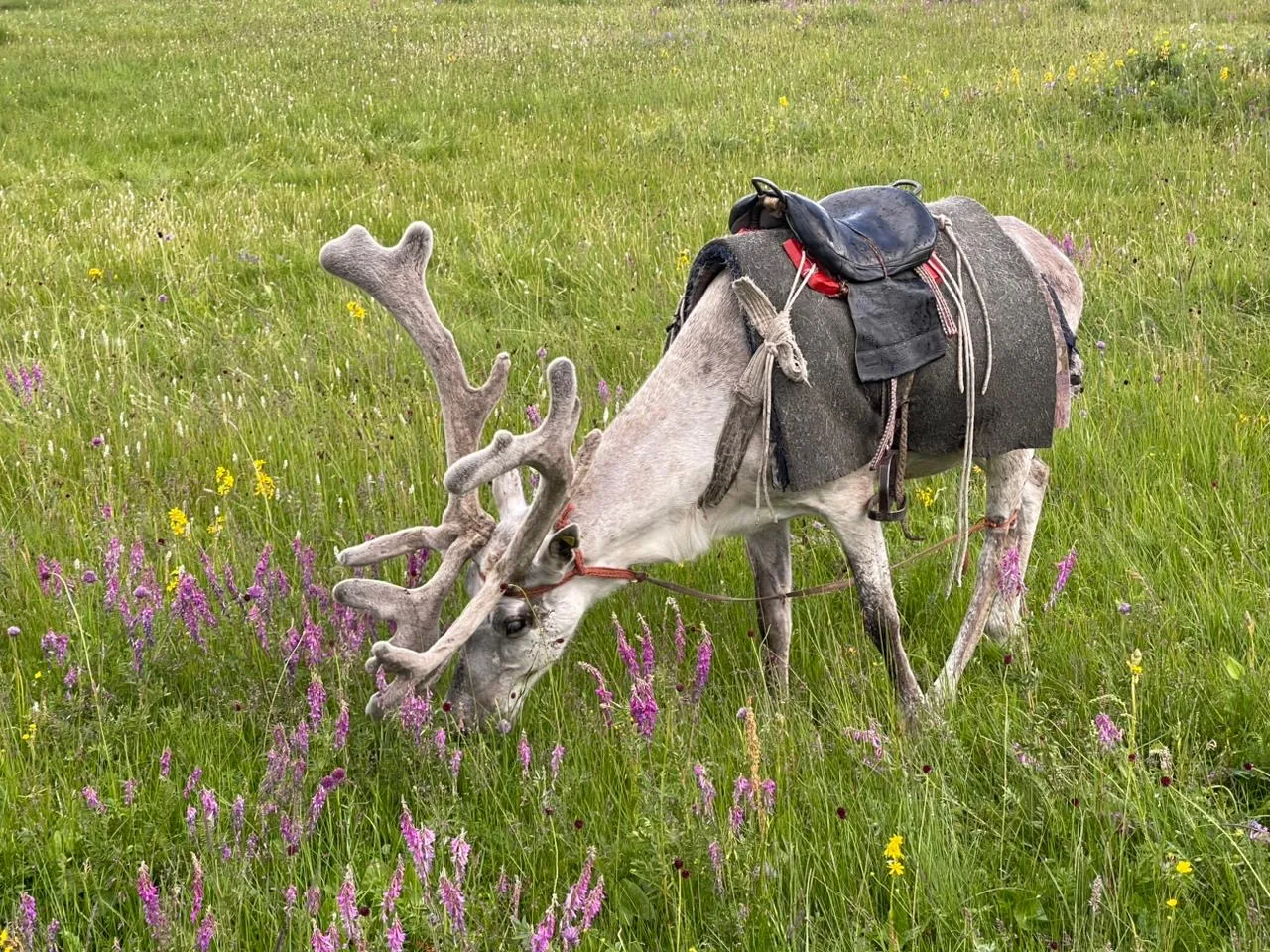
This 12-day Northern Mongolia tour with the Tsaatan is the right itinerary for travelers willing to commit to three days of horse trekking each direction in exchange for two nights at a working seasonal Tsaatan reindeer camp. The Tsaatan (also called Dukha) are an indigenous people of the East and West Taiga – around 200 to 300 people in 30 to 40 families, semi-nomadic, moving with their reindeer between seasonal pastures. They are one of the last reindeer-herding cultures left in the world. The visit is on the family's terms; you stay with them, drink salty milk tea, learn the rhythm of a household that lives in the taiga and still uses reindeer for milk, transport, and antler-sale income.

For travelers comparing options: the 7-day Northern stays close to Khuvsgul without the Tsaatan trek. The 10-day Northern adds the Khangai Mountains and Karakorum on the return instead of the Tsaatan trek. The 20-day grand tour combines this 12-day Tsaatan content with the Central and Gobi regions in a single trip. The 12-day is the right choice when the Tsaatan visit is the primary interest of the trip – you cannot reach a working Tsaatan camp without the multi-day horse trek, and there is no shorter version. Note that the season is June through August only because the Darkhad road becomes unreliable in September.

What's included.

Included

  • Private Toyota Land Cruiser or equivalent vehicle for all road transfers
  • Experienced local driver, English-speaking guide (Buya), and a horse-trek guide for the Tsaatan trek
  • All accommodation on tour: ger camps, one or two nomadic family overnights, two nights at a Tsaatan camp
  • All meals during the tour (breakfast, lunch, dinner)
  • Horses, saddles, and tack for the six days of horse trekking; tents for any wilderness camping nights
  • All entrance fees: Amarbayasgalant Monastery, Uran Togoo, Khuvsgul National Park, Uushigiin Uvur, Tengis-Shishged National Park
  • Bottled drinking water on driving days; treated water on the trek

Not included

  • International flights to and from Ulaanbaatar
  • Pre and post-tour Ulaanbaatar hotel nights (we can recommend or arrange)
  • Mandatory travel insurance with medical evacuation cover
  • Optional activities not in the itinerary (kayaking on Khuvsgul, etc.)
  • Personal expenses, alcoholic beverages, laundry
  • Gratuities for guide and driver (appreciated but not required)
  • Museum camera fees where applicable
  • Personal sleeping bag (recommended; rentals available in Ulaanbaatar)

Travel insurance is required. We recommend SafetyWing or World Nomads, see the Before-you-go guide.

Where you stay.

Most road-day nights are at established ger camps with private bedding, communal dining, and shared bathing facilities. One or two nights are with nomadic families. The two Tsaatan-camp nights are spent in or beside the family's urts (the conical tipi-style tents the Tsaatan use, made of canvas over a wooden frame). Bedding is provided at the Tsaatan camp; we recommend bringing your own sleeping bag for the trek nights or renting one in Ulaanbaatar. Toilet at the Tsaatan camp is a dug pit at a discreet distance; washing is in the stream or with a basin from boiled water. Genuinely basic – the trade-off is the experience of two nights in a working Tsaatan camp.

What to bring.

The Tsaatan trek requires more careful packing than the standard Northern tours. Essentials: layered clothing for cool nights at high elevation (the East Taiga is at 1,800 to 2,200 meters), a full rain shell (the taiga attracts afternoon rain in July and August), sturdy waterproof boots (riding boots or hiking boots), riding pants or thick trousers (jeans become uncomfortable after a full day in the saddle), thick socks, gloves for early-morning rides, a warm hat and a sun hat, sunglasses, broad-spectrum SPF, a small daypack, a headlamp with spare batteries, a reusable water bottle, hand sanitiser, and any personal medications. We recommend a sleeping bag rated to 0°C or below; rentals are available in Ulaanbaatar at our recommendation. Riding helmets are provided. A small dry bag for valuables and a power bank are useful – there is no electricity at the Tsaatan camp.

See packing notes in our Before-you-go guide →

Common questions.

Who are the Tsaatan reindeer herders?

The Tsaatan (also called Dukha) are an indigenous people of the East and West Taiga around the Darkhad Valley in northern Mongolia. They are one of the last reindeer-herding cultures left in the world – around 200 to 300 people in 30 to 40 families, semi-nomadic, moving with their reindeer between seasonal pastures. They live in conical tents (urts, similar to a tipi) rather than gers. The reindeer are the center of the household: milk, transport, antler-sale income, and cultural identity.

How much horseback riding is on the Tsaatan trek?

Three days of riding each direction (six days total), around 30 to 40 kilometers each direction. Daily riding is 4 to 6 hours, with breaks every 60 to 90 minutes and a lunch stop. Pace is mostly walk and slow trot through alpine pasture and larch forest. Total trek distance is approximately 60 to 80 kilometers across the six days. The riding is not technical, but it requires moderate fitness and at least basic prior experience on horseback.

Can I do this trip without horseback riding?

Not really – the Tsaatan camps in the East Taiga have no road access. The three-day horse trek each way is the only practical way to reach a working camp. Some travelers visit displaced Tsaatan families closer to Khuvsgul Lake; we generally recommend against this because those visits can be staged. The 7-day or 10-day Northern tours are better choices if you want a Khuvsgul trip without the trek.

Is the Tsaatan trek suitable for first-time horseback riders?

It is borderline. We recommend at least basic prior horseback experience – a few rides at a stable, comfortable on a walking and slow-trotting horse. The terrain is forgiving (mostly flat alpine pasture and gentle forest tracks) but the long daily hours in the saddle are tiring for first-time riders. If you have no riding experience, take a few lessons before the trip or choose the 7-day/10-day Northern variants instead.

What is the best time of year for the 12-day Tsaatan tour?

June through August only. The Tsaatan camps move with the seasons; June through August is when the East Taiga camps are at their most accessible summer pastures. The Darkhad Valley road becomes unreliable in September. June is the start of the season (cooler, fewer travelers); July and August are peak.

What kind of accommodation at the Tsaatan camp?

Two nights staying in or beside one of the family's urts (the conical tipi-style tents the Tsaatan use). Bedding is provided. Toilet is a dug pit at a discreet distance from camp. Washing is in the stream (cold) or with a basin from boiled water. There is no electricity, no signal, no mobile phone reception. The trade-off is the experience of two nights in an active seasonal Tsaatan camp.

What is included in the 12-day Tsaatan tour?

Specific inclusions confirmed at booking; typically: private vehicle and English-speaking driver for road days, horses and a horse trek guide for the Tsaatan trek, all accommodation (ger camps, one or two family stays, two nights at a Tsaatan camp), all meals on tour, all entrance fees including Tengis-Shishged National Park, bottled drinking water on road days, treated water on the trek. Excluded: international flights, Ulaanbaatar hotel nights, sleeping bag (rentable), travel insurance with medical evacuation cover, gratuities. Final inclusions are confirmed in writing before any payment.

How does the 12-day Tsaatan tour pace?

Days 1 to 3 are road transfers north (Amarbayasgalant, Uran Togoo, Murun). Day 4 reaches the Darkhad Valley. Days 5 to 7 are the horse trek (5 ride to camp, 6 stay at camp, 7 ride out). Day 8 returns to Khuvsgul Lake. Days 9 is a free day at the lake. Day 10 visits the Uushigiin Uvur deer stones. Days 11 to 12 return to Ulaanbaatar via Khugnu Khan. The pace allows for the trek's physicality plus rest and lake time on the return.

What are the Uushigiin Uvur deer stones?

Uushigiin Uvur is a Bronze Age archaeological site north of Murun with around 30 "deer stones" – carved stone monoliths from roughly 1,200 to 700 BCE depicting stylized deer leaping toward the sun. The deer-stone tradition is unique to the Mongolian-Siberian region and predates the Mongol Empire by 2,000 years. The site is visited as part of the Day 10 return.

Can the 12-day be combined with the Gobi or Central regions?

Yes – the 20-day grand tour adds Central Mongolia (Karakorum, Tovkhon, Tsenkher Hot Springs, the Orkhon Valley) and the Gobi Desert (Khongor Dunes, Bayanzag Flaming Cliffs, Yoliin Am, Tsagaan Suvarga) onto this Tsaatan content. It is our longest standard itinerary. For a shorter custom combination (Tsaatan + Khangai, or Tsaatan + Gobi), talk to us about a 14 to 16 day route.

Book this trip.

Baska replies personally, in your language, within 24 hours. We can adjust dates, routing, and pacing.

Chat on WhatsApp Baska replies within 24 hours, Mon–Sat (UB time). Or email us

Not sure which tour fits your dates? See the planning guide.

Other journeys in Northern

Inquire about this trip

Compare tours