Day 1: Amarbayasgalant monastery
In the morning, drive to Amarbayasgalant Monastery, one of Mongolia’s most beautiful and historic monasteries. Arrive in the afternoon and check in at a ger camp. Visit the monastery and hike the nearby hills for panoramic views of the valley and the monastery.
Day 2: Uran togoo
Urantogoo Volcano is an extinct volcano in northern Mongolia. It became inactive about 800,000 years ago. The top of the volcano is reachable by a short trek, and from the summit, you can enjoy amazing panoramic views. Urantogoo is a great place for anyone who loves nature and adventure.
Day 3: Murun city
Murun is the capital of Khuvsgul province, near Khuvsgul Lake. It’s the gateway to northern Mongolia’s nature and culture. Will take permission to the Taiga region. Stay overnight in a ger camp.
Day 4: Journey to the Beautiful Blue Darkhad Valley
After staying in Murun city, we will drive to Darkhad Valley. We will visit a local horse guide family to prepare for the next few days of horse trekking and meet the equestrian guide who will accompany us throughout the trip. Overnight stay in a traditional ger.
Day 5: Ride horses through nature and visit reindeer people
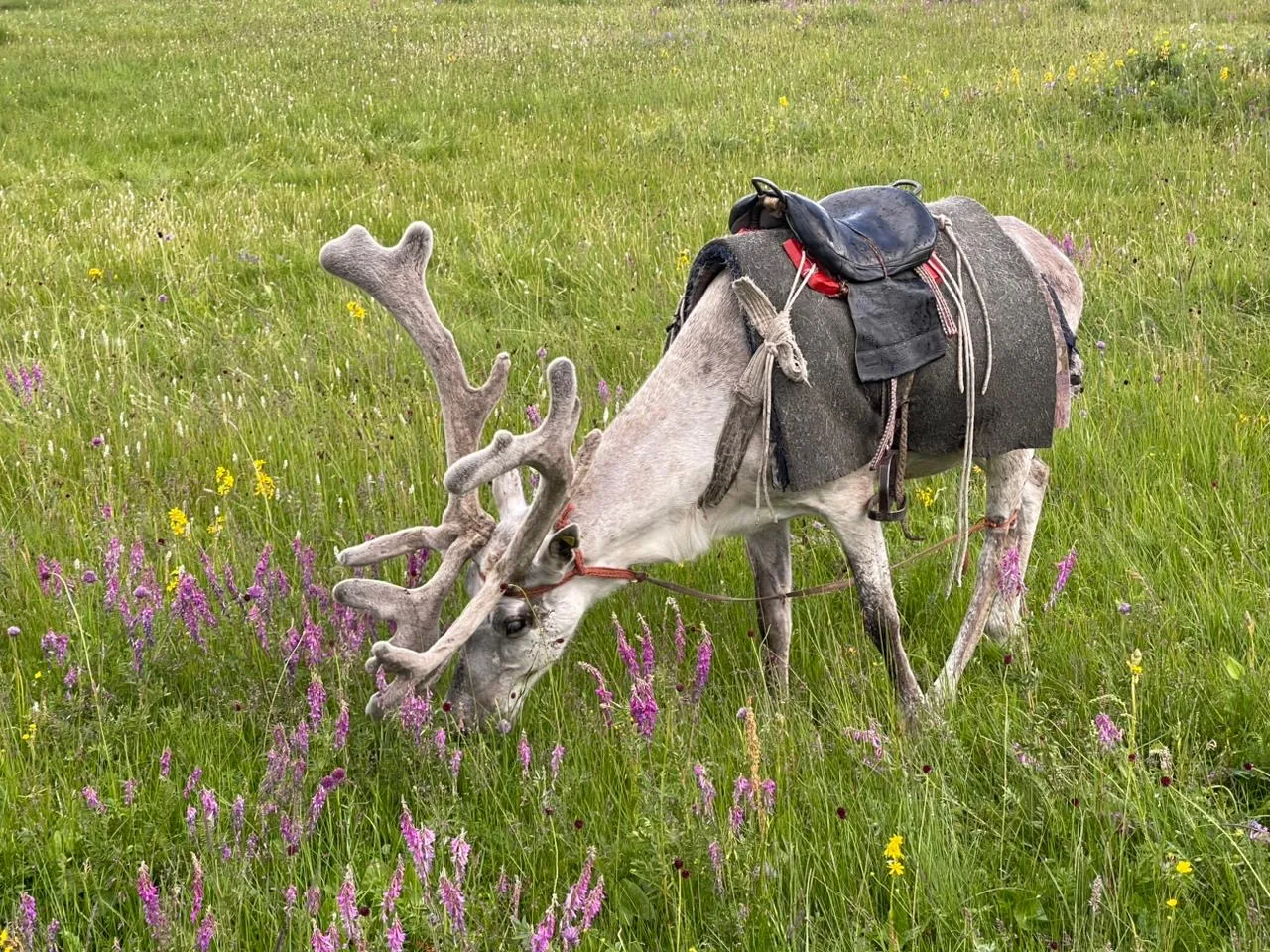
We will ride through rugged mountains and boggy valleys. Upon arrival at the reindeer camp, we will spend the night in traditional Tsaatan huts. With no light pollution in the Mongolian countryside, you can enjoy stargazing under a dazzling night sky.
Day 6: Stay another day with the reindeer people
Today, we stay in the area and continue learning about the Tsaatan (Reindeer) people. Enjoy light hiking through the taiga and mountain valleys while observing local flora and fauna. This region is rich in medicinal plants used by the reindeer herders for food and healing.
Day 7: Riding back to horse herder family
It is time to say goodbye to the Reindeer People. We pack our luggage, mount our horses, and ride back along the same trails, spending the night in a ger.
Day 8: Khuvsgul lake
Khuvsgul Lake, often called the “Blue Pearl of Mongolia,” stretches 136 km in length and 36 km in width, lying at an elevation of 1,645 meters above sea level. The lake and its surrounding region remain remarkably pristine and unspoiled.
Day 9: Off driving. We have some activities of hiking, climbing mountains, watching birds, etc
Day 10: Uushigiin Uvur Deer Stones
Located 18 km west of Murun in Khuvsgul Province, on the eastern side of Uushig, a rocky mountain, there is a burial mound and stone monuments, including a group of 14 deer stone statues in one location. This monument is one of the most distinctively depicted deer stones in Mongolia. These stones are arranged in a line, stretching from the north to the south. Stay overnight in a tent and experience the area’s natural beauty.
Day 11: Terkh white like & Khorgo volcano
Terkh white lake is a beautiful freshwater lake located in the Hangai Mountains. It was formed by the flow of Terkhin River and volcanic activity from Khorgo Volcano. The lake is 16 km long, up to 6 km wide, and 20 meters deep, sitting at an altitude of 2,060 meters above sea level. Khorgo Volcano, located on the shore of Terkh white Lake, is a dormant volcano that erupted around 8,000 years ago. The crater is 200 meters wide, 70-80 meters deep, and has slopes of 30-36 degrees. The solidified lava shows unique twisted and curved shapes, formed by the flow of molten rock and steam.
Day 12: Tsenkher hot spring
Drive to Tsenkher Hot Springs, located among forested hills, cliffs, rivers, and wide-open mountains. The mineral-rich water naturally emerges at 85.5°C and is cooled for bathing. Relax in outdoor hot pools while enjoying the surrounding natural scenery.
Day 13: Orkhon Waterfall
After breakfast, we will drive to the Orkhon Valley, a UNESCO World Heritage Site shaped by volcanic eruptions and earthquakes around 20,000 years ago. Visit Ulaantsutgalan (Orkhon) Waterfall, the largest waterfall in Central Mongolia, cascading 24 meters down a lava cliff. Stay with a local nomadic family guided by your horse guide and experience authentic nomadic life and culture. In this region, yaks become more common than other livestock, adding to the unique local experience.
Day 14: Second day at the Orkhon waterfall
Experience the nomadic way of life, culture, and traditions. We have some activities of hiking, climbing mountains.
Day 15: Bayanzag (Flamming Cliffs)
Visit Bayanzag, famously known as the Flaming Cliffs, one of the world’s most important paleontological sites. In 1922, Roy Chapman Andrews discovered the first dinosaur eggs here. Walk through the red sandstone cliffs where dinosaurs lived over 60 million years ago.
Day 16: Khongor sand dunes
Drive to the spectacular Khongor Sand Dunes, also known as the Singing Dunes due to the sound created by the wind. Climb the dunes in the early morning or evening for wide-open views of the desert landscape.
Day 17: Camel Riding
Enjoy riding the two-humped Bactrian camels, well adapted to the desert and comfortable for travelers. Experience off-road driving and immerse yourself in the vast Gobi scenery.
Day 18: Gobi Gurban Saikhan National Park & Yoliin am
Travel to Gobi Gurban Saikhan National Park, meaning “Three Beauties of the Gobi.” Explore Yoliin Am, a deep, narrow canyon that remains shaded and icy until early summer. Hike 2.0-2.5 hours through the valley, home to ibex and endangered argali sheep.
Day 19: Tsagaan Suvarga (White Stupa)
Visit Tsagaan Suvarga, meaning “White Stupa,” one of the Gobi’s most iconic landmarks. These colorful limestone cliffs rise 30-60 meters high and stretch over 400 meters. Once an ancient ocean bed, marine fossils and shells can still be found here. Hike through the cliffs for spectacular photography, especially at sunrise and sunset.
Day 20: Back to Ulaanbaatar
We will go back to Ulaanbaatar. Will have lunch on the way.